Queens University Hosts "Circle of Humanity" Event Honoring Shared Histories

Community leaders, activists, and citizens gathered for “A Circle of Humanity: An International Holocaust Remembrance Day and Martin Luther King Jr. Day Event” hosted in the Gambrell Center for the Arts and Civic Engagement at Queens University of Charlotte. The event took place on January 27, the 81st anniversary of the liberation of Auschwitz-Birkenau, a death camp responsible for the murder of approximately one million people.
The program opened with a sobering commemoration of International Holocaust Remembrance Day, led by Katie Cunningham, assistant director of the Stan Greenspon Holocaust Education Center.
“Remembrance in itself should be a paramount objective,” Cunningham stated, lighting a candle to honor survivors. “Memory matters, especially today.”
A “Shared Legacy” of Civil Rights
Sonja Gantt, executive director of the Charlotte-Mecklenburg Schools Foundation, who moderated the evening, shared personal reflections on the power of coalition. She recounted how her father, former Charlotte Mayor Harvey Gantt, co-founded an architectural firm with Jeff Huberman, a Jewish partner, in the early 1970s, a rare and courageous partnership for that era.
The highlight of the evening was the introduction of the documentary “Shared Legacies: The African American-Jewish Civil Rights Alliance.” Produced by the organization Spill the Honey, the film documents the era when Jewish leaders marched hand-in-hand with Dr. King.
As Reverend Mack noted, the evening wasn’t just about watching a film: “It really is a teachable moment, an opportunity to come together as a people and truly reflect on who we are.”
A Conversation with Dr. Benjamin Chavis Jr.
The event featured a live dialogue with civil rights icon Dr. Benjamin F. Chavis Jr., a leader of the Wilmington Ten and current chair of Spill the Honey. At 78, Chavis reflected on his decades of activism, including being arrested over 60 times in the pursuit of justice.
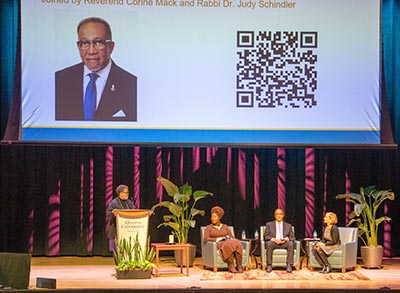
“I saw Rabbi Abraham Joshua Heschel and Dr. King almost become brothers,” Chavis told the audience. “We marched together, and we prayed together to improve the quality of life for all Americans.”
Chavis was joined on stage by Rabbi Judy Schindler, Sklut Professor of Jewish Studies at Queens University, and Reverend Corine Mack, president of the Charlotte NAACP. The trio discussed the “Circle of Humanity” project—a vision to create a permanent space for reflection and conversation, conceptually located in Charlotte’s Marshall Park.
“The truth is, there’s only one race, and that’s the human race,” Chavis declared. “We should not allow prejudice, fear, or hate to take over our understanding that we are part of one human family.”
The Power of Collaboration
The Circle of Humanity: An International Holocaust Remembrance Day and Martin Luther King Jr. Day Event was supported by community organizations, including Spill the Honey, NAACP Charlotte-Mecklenburg Branch, Stan Greenspon Holocaust Education Center at Queens University of Charlotte, Jewish Federation of Greater Charlotte, and the Charlotte Black/Jewish Alliance.
Schindler spoke to the importance of moving from shared history to active, contemporary collaboration. As an interfaith leader who has spent nearly three decades in Charlotte, she noted that the documentary is being implemented in classrooms nationwide to inspire a new generation to “affirm their pledge to promote the values of social justice.”
A “Teaching Corridor” for Charlotte
Judy LaPietra, director of the Stan Greenspon Holocaust Education Center, detailed how the city is planning to incorporate community feedback regarding the “Circle of Humanity” project into its existing memorials to transform into a living “teaching corridor.”
“At the heart of this project is the concept of interconnectedness,” LaPietra explained. “When any group is pushed outside the circle of moral concern, all of humanity is diminished. By linking the Holocaust and the American Civil Rights Movement, the Circle of Humanity highlights shared patterns of dehumanization, exclusion, and moral choice, while honoring the distinct histories of each.”
As the community discussions continue, the “Circle of Humanity” project committee is hopeful that a winning design will transform the memorials into a public classroom where shared histories can teach future generations lessons learned from the past.