Queens University Presents World Premiere of Margaret Bonds' "Bitter Laurel"

Queens University of Charlotte recently presented the world premiere of “Bitter Laurel,” often considered the final magnum opus of legendary composer Margaret Bonds. The musical was performed at the Sarah Belk Gambrell Center for the Arts and Civic Engagement on April 18 and 19, 2026, as an educational and impactful act of storytelling. The production was a “staged workshop,” presented with minimal staging to allow the historic score to take center stage.
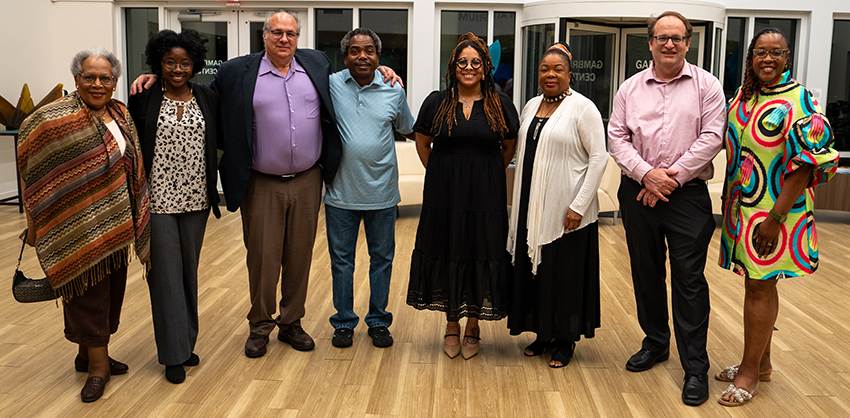
The evening prior to the premiere, the university hosted a community panel discussion to explore the deep historical and artistic layers of the production. Moderated by Queens’ Director of Choral Activities Justin Smith, DMA, the conversation brought together an esteemed group of scholars and creators, including Southwestern University music professor and Bonds biographer John Michael Cooper and instructor Christopher Washington. They were joined by UNC Charlotte faculty members Janaka Lewis, Ph.D., and visiting assistant professor of costume design, Margarette Joyner. Rounding out the panel was Queens alumna Kellie Williams ’25, who shared her unique perspective as the production’s lead, and Sequina DuBose, vocal director of the performance.
Williams described the experience as a significant professional milestone. “I was challenged musically and as an actor by the amount of material alone,” she noted. “The music and dialogue were very complex and stylistically varied. I definitely learned a lot!”
The Legacy of Margaret Bonds
Bonds (1913–1972) was a pioneer who broke racial and gender barriers. Best known for her frequent collaborations with Langston Hughes and her ability to weave the spirituals of the Black experience into classical and theatrical forms.
Left unfinished at the time of her death in 1972, “Bitter Laurel” remained a collection of fragmentary sketches for decades. The world premiere at Queens marks the first time this score has been heard in its entirety, finally placing the “missing piece” of Bonds’ legacy into American history.
A Story of Resilience: From Enslavement to the White House
“Bitter Laurel” chronicles the extraordinary life of Elizabeth Hobbs Keckley. Born into slavery in Virginia, Keckley eventually purchased her and her son’s freedom and rose to national prominence as the dressmaker to First Lady Mary Todd Lincoln. Despite her success, Keckley’s life was marked by the tragedy of the Civil War and the enduring trauma of her early years of slavery.
The program featured a sweeping musical score that included a profound song of grief, “Old Black Moon Shining,” depicting the immense pain she felt after the death of Keckley’s son, George Kirkland, contemplating what it means to live in a land that is not yet truly free.
Williams felt a deep responsibility for the historical figures she represented. “It was very humbling,” she said. “I felt it would be a tremendous undertaking to honor and do justice to the legacies of these real Black women, Bonds and Keckley.”
A Poignant Homecoming
For the Queens community, the performance carries a unique weight. The Burwell family, who once enslaved Keckley, were the founders of the Charlotte Female Institute, now Queens University of Charlotte.
“There is a unique importance in presenting this never-before-performed piece on our campus,” said Smith. “By restoring Bonds’ sketches and performing them here, we are connecting a major work of American musical theatre to a story that is deeply rooted in our own local geography and institutional history.”
Philanthropy and Partnership
The performances were made possible by a Queens University of Charlotte Noble Fellowship Award, a UNC Charlotte Faculty Research grant, and a generous anonymous donor.
“I am beyond grateful to the Noble Fellowship for providing the funding to help make this happen. It has impacted not only my work, but also that of the more than 50 singers and instrumentalists who had the opportunity to give this musical its world premiere.”
By bringing “Bitter Laurel” to life, Queens University honored the legacy of a composer whose final work was silenced for half a century, and a woman who stitched her way from bondage to the heights of American history.