Bridging Design and Community: How Queens Graphic Design Students Are Shaping the Next Generation of Local Latinx Businesses

When Melissa Gamez, associate professor of design at Queens University of Charlotte, connected with the LINK Foundation over the summer, she saw an opportunity that aligned seamlessly with the university’s motto: “Not to be served, but to serve.”
The LINK Foundation, a local nonprofit dedicated to leveraging technology to equalize access to resources for immigrants and vulnerable communities, was preparing to launch its Creative Code initiative this fall to support emerging Hispanic entrepreneurs across Charlotte.
Gamez knew immediately where this partnership belonged: her senior graphic design capstone course, and this fall all 14 students in the capstone class are putting their years of visual design and strategic thinking into practice by building complete visual identities for Hispanic entrepreneurs in the community.
Through an intensive three-week sprint, each student is paired directly with a business owner to deliver a comprehensive brand identity package including logo variations, brand guidelines, usage rules and collateral mockups which will then be handed off to LINK’s web development team to launch live client websites.
Experiential Learning with Real-World Impact
For these senior design students, the project moves beyond the typical classroom assignment. It introduces live clients, firm deadlines, and the real-world responsibility of helping a local business build its identity.
“We give them projects in the classroom all the time, but when they’re working with a live human being who has a business and a deadline to get to the next step, it actualizes that for them in a different way,” Gamez said. “This type of project also provides a great opportunity to take care of your community. We teach out students the importance of giving back. This is experiential learning built around a culturally rich heritage.”
The collaboration also offers students a chance to refine their professional communication skills and navigate cross-cultural collaboration. Because not all participating entrepreneurs are native English speakers, students utilize digital translation tools during virtual meetings on Google Meet to ensure seamless communication.
Building Bridges and Cultural Connections
During a recent classroom visit to observe initial concept creation presentations, Pedro Cordido, technology director at the LINK Foundation, highlighted the deeper purpose behind the partnership.
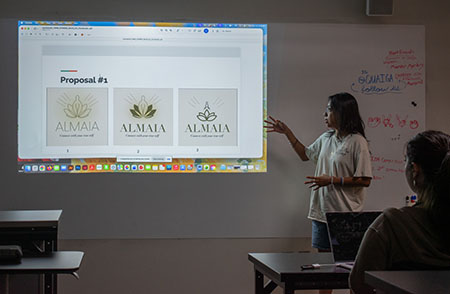
“We are here to build bridges and create new paths,” Cordido told the students. “You are in the final lap of your academic career, about to work in the real world. And today, before even graduating from Queens, you are helping people in the Charlotte community build their dreams, and at the same time, you are building your own dream.”
For two students in the class who identify with the Latinx community, the capstone project represents a deeply personal opportunity to bridge creative talent and cultural advocacy.
Anahi Maciel ’27, a double major in graphic design and business who was born in Mexico and raised in Charlotte, felt an immediate connection to the initiative.
“When I heard about the project, I thought it was a great opportunity for us as a stepping stone to the outside professional world,” Maciel shared. “Being able to help my own community allows me to ‘pay it forward’ and lets me do what I love.”
Maciel is paired with entrepreneur Camila Cruz, who is launching a holistic wellness center focused on spiritual growth, empowerment and personal transformation.
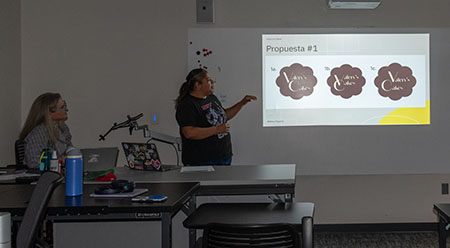
For Mandy Gutierrez ’27, a transfer student from Voorhees, New Jersey, and a student-athlete on Queens’ women’s rugby team, the initiative offered a chance to make an immediate impact in her new city. The daughter of Puerto Rican and Nicaraguan parents, Gutierrez felt a deep connection to the project’s mission.
“I originally went into art therapy because I love helping people, but I realized graphic design allowed me to create even more,” Gutierrez said. “Using my passion and skills to give back to the community is so important to me. When I spoke with my client, she said she was thrilled to work with someone who truly understood her—without worrying about anything getting lost in translation.”
Gutierrez is collaborating with Willeny Figuera, a Venezuelan entrepreneur behind Valery’s Cakes, a custom bakery named after Figuera’s daughter, specializing in cakes for quinceañeras, weddings and community events.
A Full-Circle Journey
For Gamez, watching her students lead client consultations and guide real-world brand strategy is the culmination of a four-year journey. Having taught many of these same students during their first year at Queens, she has seen them transform from timid beginners into self-assured, creative problem solvers.
“They arrive at Queens with little knowledge of graphic design — and that’s expected — so they’re naturally nervous,” Gamez said. “But by their senior year, they’ve transformed into independent strategic thinkers and creative problem solvers. Seeing that growth is my favorite part of teaching.”
Elevating Local Latinx Leaders
As the design sprint progresses, moving from initial sketches and class critiques to polished, final brand guidelines, the students gain more than just course credit. They walk away with a published, professional case study to add to their portfolios upon graduation, while local Latinx entrepreneurs receive high-caliber branding assets to launch and grow their businesses.
“Our students love these experiences and having real work that’s going to be out there in the world,” Gamez said. “This is a fantastic benefit for them, and it shows the power of giving back to the community you live in.”