Royal Voices of Charlotte Honor Rev. Jesse Jackson Through the Music of Margaret Bonds

The soulful sounds of Queens University’s Royal Voices of Charlotte lifted the heavy hearts of all who came to pay their respects to the late Reverend Jesse Jackson, a key figure of the Civil Rights Movement and South Carolina native.
The journey to perform in the heart of South Carolina began just a week prior, during a presentation by Justin Smith, DMA, director of choral activities at Queens University of Charlotte. While speaking to the Opera Carolina Guild about the works of overlooked African American composers, Smith played a recording of the choir performing Margaret Bonds’ “Credo.”
In the audience was a singer scheduled to perform at Reverend Jackson’s memorial. Struck by the “beauty and profundity” of the music, the singer approached Smith with a request to have the Royal Voices of Charlotte join her for a historic performance.
With only days to prepare, Smith reached out to current students and alumni who had performed the piece previously at Morehouse College. “There was no time to learn and polish a new piece,” Smith explained. “The work was already done in our hearts from our previous performance, and we had one rehearsal on Sunday night to find our voices again.”
Margaret Bonds’ “Credo”
The choir performed the second movement of Margaret Bonds’ “Credo,” titled “Especially Do I Believe in the Negro Race.” The choice was poignant. Bonds, a Black composer whose genius was often sidelined during her lifetime due to racial injustice, set her music to the 1900 prose of W.E.B. Du Bois.
Smith, recognized by his students as a “tireless champion” of Bonds’ legacy, noted that the Royal Voices were the first choir in the Southeast to perform this work. “It extols all the virtues the movement fought for: equality, tolerance, and dignity,” he said.
The Voices of the Students
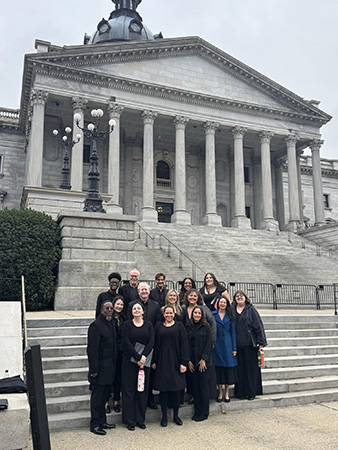
For the students standing near the casket of a man who twice ran for President and shifted the bedrock of American politics, the performance was a sacred duty.
Donovan Perkins ’26, a senior Presidential Scholar at Queens, felt the weight of his ancestors in the room. “As a young Black musician, offering music of such depth feels personal. I feel the presence of my ancestors and their collective grin,” Perkins said. “To see Margaret Bonds’ artistry honored alongside the legacy of Jesse Jackson feels like a quiet act of restoration.”
Andrea Parrone ’26, a senior specializing in vocal pedagogy, immediately called her grandmother when she learned of this honor. “She was so overwhelmed,” Parrone shared. “She told me stories about the Civil Rights Movement and Reverend Jackson’s impact. To share my voice to celebrate someone else is a privilege I do not take lightly.”
Victoria Gonzales ’27, a junior double majoring in music and political science, noted the significance of traveling from her home in New Mexico to represent Queens at such a historical event. “My family is beyond proud,” she said. “This song speaks to how African Americans deserve the same rights as everyone else—the exact thing Reverend Jackson fought for.”
“It was an absolute shock,” recalled Queens University alumna Kellie Williams ’25. “I couldn’t believe it! He was a trailblazer and a stalwart in the fight for civil rights. He will be missed!”
A Legacy of Mentorship
The students reflected on the leadership that brought them there.
Perkins credited Smith with expanding his artistry to international stages, from Greece to Canada, but emphasized that his “intentionality in uplifting the Black community” is what truly defines his leadership.
Williams added that as a transfer student, Smith’s “wholehearted embrace” and attention to African American composers had a major impact on her experience at Queens.
The Final Note
For the Royal Voices of Charlotte, performing at this memorial was the ultimate validation of their work with Smith; it was a moment where the ‘Credo’ they had practiced in the at Queens became a living testament to the equality Reverend Jackson spent his life defending.