Queens University Explores "AI and the Future of Everything" at Latest Learning Society Event

On March 26, the Learning Society at Queens University welcomed Nita Farahany, founding director of the Duke Initiative for Science & Society, and Nicholas Thompson, CEO of “The Atlantic,” for a deep dive into the rapidly evolving world of artificial intelligence (AI). Combining their expertise in law, philosophy, and media, Farahany and Thompson discussed how AI is reshaping the landscape of human thought, modern journalism, and global ethics.
Throughout the evening, audience members contemplated whether AI is a catalyst for accelerating human potential or a threat to mental autonomy. Queens University President Jesse Cureton ’02 shared his optimism for the future but emphasized that there must be clear boundaries.
“Although these tools are beneficial, they can never be a substitute for human connection,” Cureton said. “Whether in a hospital room or a boardroom, any remarkable experience is defined by people.”
The discussion between Farahany and Thompson touched the surface of AI agents, cognitive offloading, and digital addiction. While Thompson emphasized individual agency and recommended that users turn off notifications and set strict timers, Farahany likened the current social media landscape to giving people a highly addictive substance and then asking them to set a timer for their doses.
“What we’re losing is the capacity to think freely,” Farahany told the audience. She argued that modern algorithms are not just suggesting content but actively steering human choices and disassociating users from their own executive functions because of the manipulative designs of the platform.
On the future of journalism, Thompson argued that engaging with AI in specific ways will be important for survival, calling adaptation a necessary strategy rather than an endorsement of automation. He clarified that human creativity, authentic writing, and editorial judgment are key to preserving the core values of journalism.
“AI might destroy journalism,” said Thompson, “But if your response is to close your eyes and pretend this isn’t happening, it’s going to come a lot faster.”
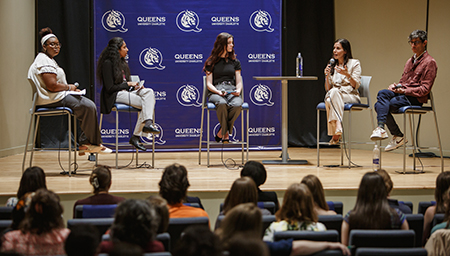
During the pre-event student discussion, Sarah Fatherly, Ph.D., provost and vice president for academic affairs, noted that while AI is already integrated into the students’ fields of study, the real work lies in the ethical questions behind the technology.
“From business and health care to communication, law, and the arts, AI is already shaping nearly every field our students are studying at Queens,” said Fatherly. “But just as important as the technology itself are the questions behind it. How can we ensure these tools ultimately serve humanity in thoughtful and ethical ways?”
As part of the student panel, Sandhya (Sana) Konar ’28, a pre-medical student at Queens, asked Farahany and Thompson thought-provoking questions about the implications of AI and its impact on the developing minds of young adults.
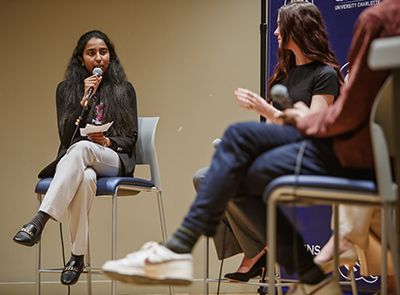
Farahany raised concerns about how curated algorithms can narrow exposure to a diverse range of ideas and perspectives, with the potential to shape preferences and habits before young adults are fully able to do so autonomously.
In the areas of medicine and healthcare, Farahany shared her hopeful insights on AI’s impact on diagnostics and radiology, earlier risk identification, and interventions. Thompson considered AI as a potential resource for providing companionship and social connection for older adults who are isolated.
Konar shared her enthusiasm for a career where technology and caregiving intersect. “AI has amazing applications in medicine, especially in areas of imaging,” said Konar. “As I pursue my studies in the pre-medical field, I anticipate a lot of innovative changes in the future.”
Although technological progress is moving fast, Konar maintains that human interaction is the vital link in healthcare. “Empathy is a huge component of patient care, and caring and delivering news in a vulnerable and compassionate way is very important for physicians,” she said. “I foresee that the human heart will continue to be crucial in the delivery of medical care.”
As the evening concluded, the audience was left to contemplate “AI and the Future of Everything.” Whether discussing the statistical likelihood of human extinction, known as p(doom), or the reality of AI agents operating in virtual sandboxes, the core takeaway was undeniable: the preservation of free thought is essential in upholding the human experience.
“Conversations like this are exactly why the Learning Society exists,” said Cureton. “They give us space not just to absorb information, but to reflect, question, and engage with ideas that will shape the future our students will inherit.”
Photo credit: Tricia Coyle Photography