The Past, Preserved: A Look Inside Queens University of Charlotte’s Archive
Blog
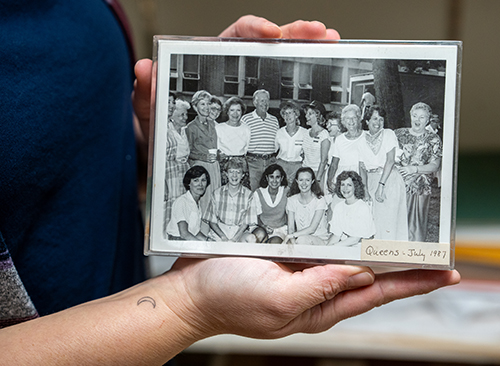
During times of change and transition, the importance of maintaining an institutional archive becomes more important than ever. The Queens University of Charlotte Archives and Special Collections are more than just repositories of papers and photographs — they’re the living memory of the university.
Sarah Sowa, Archives and Special Collections librarian at Queens University’s Everett Library, shared in a recent interview that “archives remind us of the people and lives that shaped the institution.” They represent the stories and the legacy of the students, faculty, and staff who walked these halls.
Archives provide vital evidence and context needed for the future, ensuring that remarkable history and hard-earned lessons are not lost. With that in mind, let’s turn it over to Sarah, who recently highlighted a selection of items that illuminate our history.
1. “Charlotte Sophia, Queen of Great Britain and Ireland” (ca. 1765). Attributed to Johann Zoffany
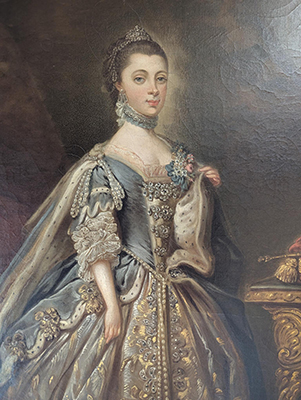
This portrait of Queen Charlotte (1744-1818), born Princess Charlotte of Mecklenburg-Strelitz, is rendered in oil on canvas and is described as a “miniature,” despite measuring 32 inches by 37.25 inches. This portrait, bordered by an intricately carved, gilt wood frame, was commissioned by Queen Charlotte as a gift for Royal Governess and friend, Lady Charlotte Finch. There is something beautiful about this painting of Queen Charlotte, for whom our city and university are named, having journeyed thousands of miles over hundreds of years to join the Queens Archives. The fact that it was created especially as a gift to a dear friend makes it even better.
2. “Our Mother and Our Queen: A History of Queens College,” by Rena C. Harrell
If you’ve visited Everett Library, you’ve probably seen her name, whether in the Rena C. Harrell Special Collections Room, the Rena C. Harrell Archives Storage Room, or the Rena C. Harrell exhibit created this summer by a student intern. Miss Harrell served as librarian at Queens College for over 37 years, as well as being a Queens alum and history enthusiast. Harrell’s manuscript, “Our Mother and Our Queen: A History of Queens College,” chronicles the history of Queens from its “ancestral roots” to 1950. The Archives also holds the Rena Harrell Collection, which contains correspondence, notes, and other materials from her research for this project. In 1980, Queens Chemistry Professor Dr. Mildred Morse McEwen published an updated book of Queens history, “Queens College, Yesterday and Today,” which relied heavily on Harrell’s previous research. In the same way that Dr. McEwen and Miss Harrell are inextricably connected, so, by her own admission, was Queens “part and parcel of [Harrell’s] existence.”
3. Records from Queens’ historical predecessors (Charlotte Female Institute [1857-1891], and the Seminary for Girls [1891-1896], the Presbyterian Female College [1896-1912]) and from Chicora College for Women, which merged with Queens in 1930
Many people may not know that the merger with Elon University is not the first institutional merger in our history. In the fall of 1930, Chicora College for Women in Columbia, South Carolina, merged with Queens College. This merger changed the lives of numerous young women who attended (or planned to attend) Chicora but ended up at Queens instead. The new combined entity was known as Queens-Chicora College from its inception through 1939, when it once again went by the name Queens College.
Today, the Queens Archives includes many relics of Chicora College, including correspondence about the merger, registrar documents, yearbooks, handbooks, trophies, newspaper clippings, photographs, and ephemera. The Archives is also home to similar artifacts from Queens’ other historical predecessors, including the Charlotte Female Institute, the Seminary for Girls, and the Presbyterian Female College. With their students long deceased and the institutions themselves long gone, these collections are irreplaceable and essential to the story of Queens’ history. Our evolution — including victories, failings, and the people who brought us to where we are today — is tucked away in the Archives, out of sight but never forgotten, always accessible to curious researchers.
4. Queens Semiquincentennial Oral History Project (2006-2007)
These oral history interviews were conducted from 2006-2007 in celebration of the sesquicentennial anniversary of the founding of Queens’ first historical predecessor, the Charlotte Female Institute. Interviewees included female Queens alumni who graduated between 1928-1949, plus one faculty emeritus who taught at Queens from 1987-2001. Interviews were conducted primarily by younger Queens alumni and staff.
Audio recordings of oral histories bring researchers much closer to their subjects than a simple transcript. They put listeners in the room with the interview participants. You can hear the creak of a chair, traffic, and birdsong. I would argue that you can hear smiles, heartache, and grudges, too. From the Great Depression to why and how they decided to attend college, these recordings bring the interviewees and their experiences to life.
5. Jane Pratt scrapbook
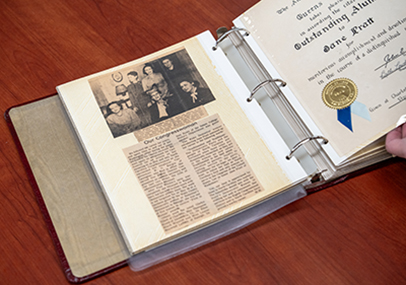
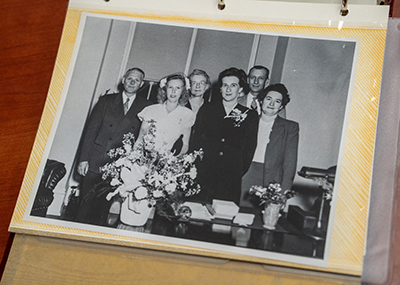
In October 2024, author Marion Deerhake visited Queens to speak about her new book, “Jane Pratt: North Carolina’s First Congresswoman.” Pratt’s first cousin, once removed, Deerhake was inspired by her mother to write this first and only biography about Pratt’s incredible life. Pratt was not only the first North Carolina congresswoman, but she also worked as a newspaper editor when the profession was dominated by men, and she served in various roles throughout the federal government. Before any of that transpired, however, she was a student at Queens College. You can find her listed in the 1920 yearbook, “Wise and Otherwise“. Unfortunately, her father’s failing health forced her to return home that same year to help support her family.
Pratt’s niece, Margaret (Marty) Pratt Keeton, attended Deerhake’s reading at Queens. Deerhake and Keeton met as a result of Deerhake’s research, although anyone observing them might have mistaken them for long-time friends or close family members. After hearing about Deerhake’s book, I was excited to speak to Keeton, who knew Pratt well.
“If you had to describe Jane in one word,” I asked, “what would it be?”
“Imposing,” she responded instantly. This was due in part to her height (Keeton is quite tall herself), but mostly due to her commanding demeanor. She did not hesitate to speak her mind.
Keeton then said that she had something for me, if I would like to have it for the Archives. She presented me with a scrapbook, explaining that her mother had assembled it over many years, documenting her sister’s life from birth to death with photos, news clippings, official documents, and more. I accepted it with gratitude and a flicker of disbelief, which I always feel when entrusted with something so precious.
This scrapbook and its journey to Queens represent a network of people, events, and relationships spanning over 120 years. Likewise, our Archives and Special Collections at Queens tell the story of our vast and intricate history, which is inextricably tied to the broader history of Charlotte, North Carolina, and beyond.
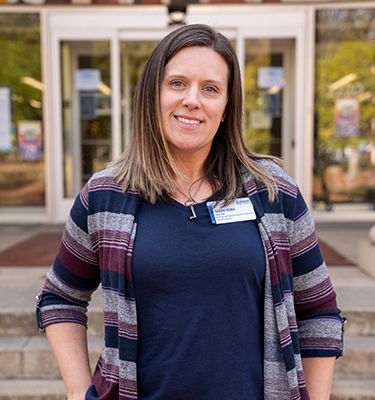
Sarah Sowa
Archives and Special Collections Librarian