Deeply Rooted: How Haley Hibbert Frey '01 Cultivates Community at Queens

If you make your way to the third floor of the Rogers Science Building at Queens University of Charlotte, you’ll find the Crowder Greenhouse. Through its doors, the sounds of campus instantly fade, replaced by the rustle of leaves, the earthy scent of soil, and the energy of a living conservatory. This rainforest-like oasis, made possible through the generosity of Christy ’82 and Otis Crowder, was intentionally designed to support faculty and student research. However, through the years, it has evolved into a classroom, a hands-on laboratory, and a restorative escape for the entire Queens community.
At the center of it all is Haley Hibbert Frey ’01, operations manager, whose history with Queens is as deeply rooted as the botanicals she tends. For Frey, the Crowder Greenhouse serves as a vital emotional “reset button” on campus.
Greenhouse Dreams
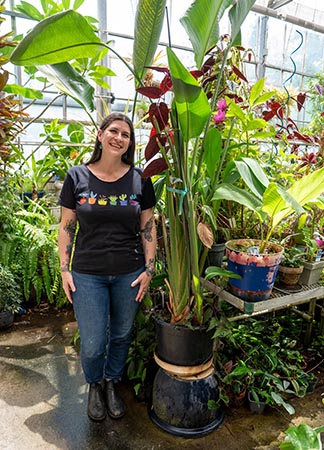
Frey’s journey at Queens began in August of 1998 as a transfer student when the university was still known as Queens College. During her first year, the space that held the original campus greenhouse was demolished to make way for the North Parking Deck.
“I was part of the plant rescue there with the other biology majors,” Frey recalls. “I actually still have some of those plants from that greenhouse rescue mission with me today.”
After graduating on the front lawn in 2001 and a brief stint in environmental chemistry elsewhere, Frey returned to Queens in 2003 to work in the Presbyterian School of Nursing’s microbiology labs. When early discussions began for a new science building, she advocated for a botanical space that could be enjoyed by all members of the Queens community. “When the administrations said they’d need to find someone to take care of it, I said, ‘I’ll do it!'” recounted Frey.
Though plans were put on hold for a while, Frey kept preparing. She earned her Master of Science in Forestry and Horticulture from NC State, taught as an adjunct professor at Queens, and managed the indoor rainforest at Discovery Place.
Then came the moment that would change Frey’s life. Walking past the newly erected construction fences on campus, she spotted the architectural renderings. The words “Rooftop Greenhouse and Herbarium” were printed on the graphic banner.
“I called my former professor, Dr. Reed Perkins, and asked him if they were seriously building the greenhouse,” Frey recounts. “And he said, ‘Yeah, do you still want that job?’ I was like, ‘Of course!'”
In October 2013, Frey officially moved into the new space. By September 2014, the first plants had arrived, cementing a full-circle homecoming fifteen years in the making.
A Conservatory Style Space for All
While the Crowder Greenhouse was originally designed to support botanical studies, it has evolved into a multidisciplinary, conservatory-style hub. Anatomy and physiology students visit to study carnivorous plants, ecology students observe insect life cycles, and local elementary school students visit for field trips.
Yet, its most profound impact might be its role as an academic oasis. Students from all walks of campus life — from music therapy and art to athletics — regularly volunteer, intern, or simply pull up a chair to study.
“This is almost like a reset button for some people’s brains,” Haley said. “Especially for students who are constantly balancing academics and a busy student life. Sometimes you just need a moment of calm, and this space provides that.”
Frey runs the Crowder Greenhouse with a generous heart and mind. An expert in plant propagation, she refuses to let trimmings go to waste. “The greenhouse has a finite amount of space, but things keep growing,” she said. “If I cut something back, I can’t, with a clear conscience, just throw it away. So, if people come to the greenhouse, they don’t leave empty-handed…unless they want to!”
For those who claim they lack a green thumb, Frey serves as a patient mentor. “People have told me they can’t even care for a succulent. And I tell them, ‘That’s not what you should have started with. We can get you there!'”
Walter and the Oily Fern
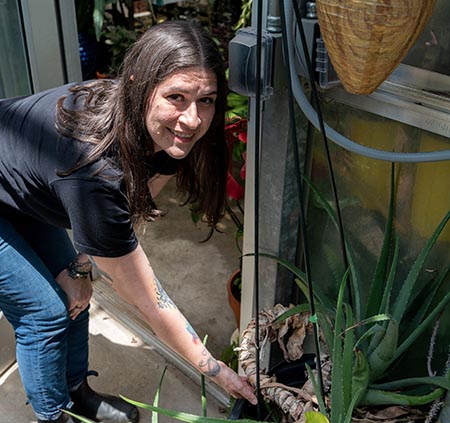
Every plant in the Crowder Greenhouse has a story, and some even have names. Walter, the resident aloe plant, is estimated to be between 35 and 40 years old. Walter is more than just a local legend, Walter is a contributor to modern medicine, having donated mature cells to medical researchers for cancer research projects.
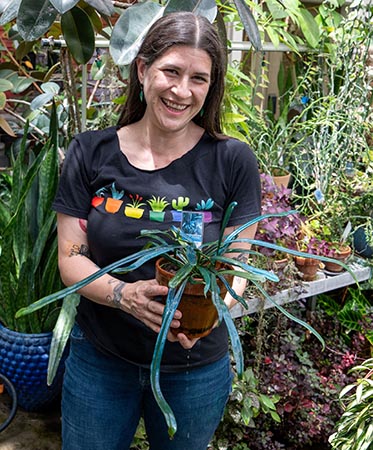
When asked about her personal favorite, Frey picks up a blue oil fern. “I love this plant so much because it doesn’t look like a fern and it’s just weird and slow growing,” she says. “Everything about it says ‘I’m not a fern;’ but it is. I love it for that. It’s just the oddball.”
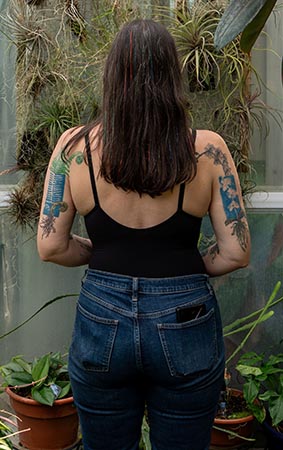
Frey’s connection to botanical history is even etched onto her skin. She sports intricate tattoos on the back of each arm —one is a fern, the other an orchid — layered in three historical botanical styles: traditional dried pressing, a sun-reactive cyanotype dye, and modern structural X-rays that reveal the inner spores and flowers. It is a beautiful, permanent tribute to the living, breathing plants in her care, which require constant attention.
The Grounding Power of Plants
Operating a greenhouse on the third floor of a campus building presents unique challenges. Facing a temperamental North Carolina climate that swings from 16°F winter mornings to 106°F summer afternoons, managing the facility requires constant vigilance.
For Frey, the daily demands of tending to a living, breathing ecosystem are exactly what makes it essential for wellbeing. In a high-stress, tech-driven world, she believes getting your hands dirty is the ultimate form of mindfulness.
“Plants teach you patience because nothing’s going to happen fast here,” she said. “When you work with plants, you have to stop and think about what you’re doing with your hands. Having them in the dirt really grounds you.”
More than two decades after her plant-saving mission, Frey has created a soothing sanctuary for both humans and botanicals. As she looks out the window, she contemplates the future. “I don’t think there’s room up here for a parking deck, so I’m hopeful that the Crowder Greenhouse will be here for years to come.”