Student poetry and classical music intertwine in annual Charlotte Symphony Orchestra collaboration

A collaboration between Queens University of Charlotte and the Charlotte Symphony Orchestra celebrated its fifth year this October for student poetry to be set into motion alongside classical performance pieces, creating a harmonic dialogue between literature and music.
Community members gathered on Oct. 28 in the Sarah Belk Gambrell Center for the Arts and Civic Engagement for “Words + Music: From Darkness to Light.” The performance paired original spoken word poetry with live orchestral works.
A Living Tradition Rooted in the Community
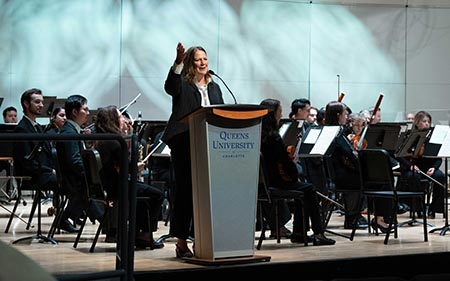
The Charlotte Symphony’s relationship with Queens goes back decades, from performances on campus beginning in the 1970s to the contributions of Dr. George Stegner, who chaired the music department and provided program notes for the Symphony for nearly 40 years,” said Charlotte Symphony Orchestra President and CEO David Fisk. “This history reflects a shared belief in the value of creating opportunities for students to engage with live music as both performers and listeners, strengthening the college community through the arts.”
Looking toward the future, Fisk expressed enthusiasm for continuing to build on this foundation alongside Elon University.
“For generations, this campus has been one of Charlotte’s homes for the arts,” said Elon University President Connie Ledoux Book. “Just last month, we pledged that we’ll continue to be an intellectual, cultural and civic convener for the city and to provide leadership as a partner. Tonight is the embodiment of that pledge in action.”
From Concept to Stage: Reimagining Classical Masterpieces
Months before the house lights dimmed, the creative process began through close coordination between faculty and conductors. Queens University Associate Professor Sarah Creech shared a call for submissions around broad emotional themes like chaos, grief, loss, remembrance, transformation and healing.
“Grief, and the way we explore it, is different based on where we are in our life journey, but the heaviness of it is something that audiences will connect with no matter who’s listening,” Creech said.
Emily Allison ’28, a double major in creative writing and professional writing and rhetoric from Frisco, Texas, returned to the collaboration for her second time after performing during her first year at Queens.
Opening the evening, Allison performed her poem “ordinary things,” which began as a flash nonfiction essay in Creech’s class before evolving into lyrical verse.
“It started as a nonfiction essay about sitting quietly in a moment of happiness while simultaneously wondering how to think about grief and loving people,” Allison said. “Eventually, you realize you will have grief of this moment ending, grief of losing people and grief of things that haven’t even happened yet.”
For Charlotte-native Maya Baker ’30, a creative writing and literary studies major, stepping onto the stage marked a brand-new milestone. Baker wrote and performed “Kaleidoscope,” which weaves together memories of her upbringing with her mother and grandmother, the passing of her father and the moments that bring her joy.
Supported in the audience by her family and drawing on a lifelong appreciation for classical music nurtured by a cousin who plays the violin, Baker discovered the bravery required to share her authentic voice aloud.
“The biggest thing for me has been being brave enough to read my own work out loud,” Baker shared. “Stepping on stage has taught me to use my voice and be more willing to share and be vulnerable.”
For senior creative writing major Nolan Kehrli ’27 from Hampton, South Carolina, returning for his second year as a performer meant shifting focus from last year’s theme of love to grapple with this year’s exploration of grief and loss. Kehrli’s poem, “Muscle Memory,” was written about his cat, Grim, who passed away around Christmas last year.
“One of the things I learned from this experience was that there’s no one way to talk about loss,” said Kehrli. “It’s a thing that separates us from one world and another but also can bring people together.”
Poetry as Collective Healing
Each student credited Creech with providing invaluable mentorship, stepping back to let peers workshop and uplift one another while ensuring their authentic voices remained uncompromised.
This year’s collaboration carried profound emotional resonance. Navigating a semester marked by campus loss and remembrance, the student poets turned to art as a vehicle for shared healing.
“It’s been really beautiful to watch my peers use the art of poetry as a way to work through grief and to share it with an audience,” said Allison. “It makes us feel less alone and is proof that poetry can be collaborative and healing.”
Kehrli agreed. “Music and poetry, grief and recovery is one of the weirdest and most beautiful ways people can come together,” he said.
Looking Forward
For the leaders who brought the evening to life, the collaboration is about more than a single evening of performance, but an investment in the next generation of creators. Charlotte Symphony Orchestra Resident Conductor Christopher James Lees sees the partnership as a powerful way to bridge classical music with contemporary voices.
“We’re all very familiar with that quote attributed to Hans Christian Andersen that said, ‘When words fail, music speaks,'” Lees said. “But this collaboration seeks to once again explore what the relationship might be like between music that speaks and poetry that sings, and the idea that works of art that have been with us for so long can inspire a new generation of individual thoughts and feelings.”
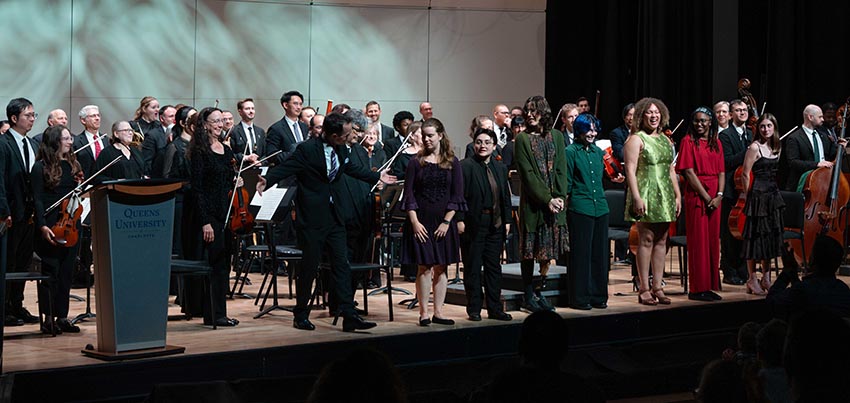
ordinary things
by Emily Allison
it is september, & we will remember it differently.
i watch a house spider climb its thick web in the sunlight. it does not tangle itself
but walks weightless over the strands that have wrapped so tightly they look like gauze.
beside me, c. types on his laptop while a summer storm collects around us. i watch c.
watch the air. i look up at the ceiling & back down at my knees. he sneezes, i bless him,
this is all so normal. & it is—don’t let me fool you, this all really is normal. we speak
on a julia roberts film, listen to trio jazz, watch yesterday’s rain drip from the redford tree
& contemplate academic privilege. these are normal thoughts to have in this normal life,
normal things to talk about and mention and get wrong. i think about running my fingers
through the house spider’s thick web. cobweb? spiderweb? what will this balcony be
when we leave it—a casing of all the thoughts we’ve caught & colored? can we only
name things in their absence? can i grieve c. now? my mother? the child i do not have,
the child i may never have? when the house spider leaves, dies, picks another balcony
with another redford tree, we will not grieve—we will clean.
is that what we’re all doing? is grief just cleaning the balcony?
i am allowed to think here. i promise i can think good things, write good things, buy the right
car seat one day for c. and i to hold our child in. she will think big things too, stand in moving water, uncross her knees & tumble through the grass & do all the things adventurous women do.
i will learn recklessness from her, from her cherry smile, from the eyes i gaze into now
that will be softer on her face—she will have c.’s eyes. she will fold into my lap & press her knees
into my hipbones. the ink on her fingers will color the hems of the fabric because she is drawing
a child’s drawing of our balcony. maybe there is pink, a bright pink for the redford tree, a robin egg blue for the balcony, a light pencil sketch for the white of the house spider’s web. she could color this shirt, i would think to myself, i would let her cling to me & color on my shirt.
Kaleidoscope
By Maya Baker
the mandalas I see the world through
are composed of color and light
the kindness and strength
of the women who raised me
my mother and grandmother
warm amber and carolina blue
the deep navy loss of my father
before getting to know him fully
and our shared golden love of
singing and breakfast
watching kelly green sugar maples
dance in the wind
and melt into firey orange puddles
on the decaying umber floor
churning and tickling
bubbles of seafoam
crashing over me
during cyan summers
spent with sun kissed cheeks
cobalt thunderstorms of letting go
and lilac shavasana of
finding contentment where I am
violet ties to two different cultures
creating my iridescent space
in the tessellation
My mosaics cast reflections
tinting the glass I see through
everywhere I look
I see prisms of
color and light
Muscle Memory
By Nolan Kehrli
I slip on fake wood floors, fluffy socks from
A Christmas you never got to see.
I still go to the living room
I guess I’m looking for you.
I stare at my parents their eyes
Stuck to their screens, refusing to look
anywhere you once were.
My brain fills with the fog of a spirit halloween
And I turn around, ashamed. Stiff.
I almost bump into your cat tree.
With the chewed up toys
you’d play with, before you got tired.
In my attempt to turn tail and run.
my body still believes you’re alive,
carrying me to your bowl.
But not the you that I want to remember.
Not the one with the angry expression, but a grimace.
The one that was wobbly and became a
Picky eater.
I almost had to look in the bags we keep your food in
we were gonna donate it, my stepmom who we called your mom
lost $50, and dad wanted me to go through it.
I would’ve. Maybe just to go back to the routine of organizing
keeping everything in its place and figuring out
what you’d eat, and what you’d leave on the carpet.
My hands itch for them sometimes, the cans.
I’m tired of this deja vu, the angry part
Wants to remove my legs, so they don’t carry me any
Closer to where you used to curl.
I get long plush blankets just to pet something again.